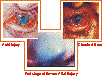
CHEMICAL INJURIES OF THE EYE

       Chemical burns are among the most urgent of ocular emergencies often resulting in a dramatic fall in the visual acuity or sometimes even loss of the eye.
This topic is of importance as it is a common condition encountered by any general practitioner or opthalmologist and the first aid given goes a long way in deciding the ultimate visual prognosis. The rapidity with which therapy is initiated decides the ultimate prognosis.

      
Chemical injuries usually occur as an occupational hazard.
TYPES : The commonly encountered chemical burns are
  1. Alkalies - Lime, Caustic Lye, Cement, Ammonium Hydroxide.
  2. Acids - Acid Batteries (25% H2 SO4), Nitric Acid, Acetic Acid.
  3. Detergents.
ACIDS VERSUS ALKALIES : Unlike the common general belief, Alkalies are more hazardous when compared to Acids due to their deeper penetration and longer duration of damage.
Depending upon the extent of damage chemical burns can be classified as follows:
MILD BURNS: Conjunctival congestion & chemosis Scattered areas of SCH Mild epithelium damage No ant chamber reaction No perilimbal ischeamia or Lens changes.
MODERATE BURNS: Periocular dermal injury Chemosis & Congestion Scatterd areas of Perilimbal ischaemia (i.e. Blanching) Perilimbal ischaemia extent - descides the prognosis of recovery. Anterior chamber reaction is very common. Temporary elevation of intra ocular pressure. Corneal epithelial damage and corneal edema.
SEVERE BURNS : Severe Chemosis Severe Perirlimbal ischaemia (almost total) Cornea opaque due to severe corneal edema Severe anterior chamber reaction Severe lens changes.

TREATMENT: Rapidity With Which Treatment Is Initiated Decides The Ultimate Prognosis, Hence Treatment Should be Immediate.
IRRIGATION: 1st step in treatment is thorough irrigation with normal saline for a minimum period of 30 mins
DEBRIDEMENT: This follows irrigation and is done to remove the residual matter present in the fornices.
ANTIBIOTICS: Preferably, Ciprofraxacin drops 4 times a day to prevent secondary infection till the corneal epithelial defect heals.
CYCLOPLEGICS: Preferably, Cyclopentolate or Homatropine drops twice a day should be instilled, to treat anterior chamber reaction which is very common.
TOPICAL STEROIDS: Can be safely instilled in the 1st and 4th weeks to treat anterior reaction but should be avoided in the 2nd and 3rd weeks as it prevents collagen synthesis facilitating corneal ulceration.
ORAL ANALGESICS: To combat pain and inflammation.
IN MODERATE CASES: Vit C Tablets : T. Celine 150gms twice a day (promotes collagen synthesis)
Tetracycline: Doxycyclin 100mg twice a day (prevents polymorphonucleat infiltration & inhibits collagenase)
IN SEVERE CASES: Treatment is directed towards correcting :
a) Dry eye-by tear substitutes b) Re-establishment of lid movement-by correction of symblepharon and cicatritial entropion. c) Restoration of integrity of eyeball-by buccal mucus membrane grafts and cyanoacrylate glue to seal small perforations. d) Restoration and visual aucuity-Penetrating keratoplasty and keratoprosthesis.


<<Previous Page >>Next Page